Understanding Fourier Series
December 27, 2025 dummy math signal-processing
The Fourier Series is a way to represent a function as the sum of simple sine waves1. More formally, it decomposes any periodic function or periodic signal into the sum of a (possibly infinite) set of simple oscillating functions, namely sines and cosines.
The Definition
Let $f(x)$ be a periodic function with period $2L$. The Fourier series of $f(x)$ is given by:
\[f(x) = \frac{a_0}{2} + \sum_{n=1}^{\infty} \left[ a_n \cos\left(\frac{n\pi x}{L}\right) + b_n \sin\left(\frac{n\pi x}{L}\right) \right]\]Where the coefficients are defined as:
\[a_n = \frac{1}{L} \int_{-L}^{L} f(x) \cos\left(\frac{n\pi x}{L}\right) dx\] \[b_n = \frac{1}{L} \int_{-L}^{L} f(x) \sin\left(\frac{n\pi x}{L}\right) dx\]Visualization
Here is a visual representation of how adding more terms approximates a square wave:
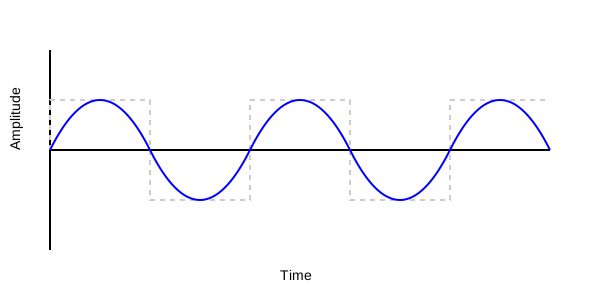
Figure 1: Approximation of a square wave using Fourier Series.
Applications
Fourier series are used in:
- Signal Processing: Filtering and compression.
- Heat Distribution: Solving the heat equation1.
- Quantum Mechanics: Wave functions.
Comments