<?xml version="1.0" encoding="utf-8"?><feed xmlns="http://www.w3.org/2005/Atom" ><generator uri="https://jekyllrb.com/" version="3.10.0">Jekyll</generator><link href="https://mikel-zhobro.github.io/feed.xml" rel="self" type="application/atom+xml" /><link href="https://mikel-zhobro.github.io/" rel="alternate" type="text/html" /><updated>2026-05-12T13:28:15+00:00</updated><id>https://mikel-zhobro.github.io/feed.xml</id><title type="html">Mikel Zhobro</title><subtitle>I’m a PhD student with Prof. [Georg Martius](https://uni-tuebingen.de/fakultaeten/mathematisch-naturwissenschaftliche-fakultaet/fachbereiche/informatik/lehrstuehle/distributed-intelligence/team/prof-dr-georg-martius/) and since November 2023, I&apos;ve been part of the Autonomous Learning Group at the University of Tübingen and MPI‑IS. Previously, I spent some time at the [EV](https://is.mpg.de/ev) under Jorg Stückler and [LDS](https://is.mpg.de/lds) under [Michael Muehlebach](https://sites.google.com/view/mmuehlebach).
Not so long ago, I earned an M.Sc. in Electrical Engineering from RWTH Aachen and an M.Sc. in Computer Science from KTH Royal Institute of Technology.
My main focus is on spatial intelligence. In particular, I am developing temporal world models with inherent 3D spatial consistency both for generation and downstream robotics tasks. In the long term, I aim to scale these models to videos in the wild in a morphology‑agnostic way, from humans to robotic arms and beyond.
Outside of my research, I am fascinated by open-ended learning and keep an eye on the latest developments in the field.</subtitle><entry><title type="html">3d-world-sim</title><link href="https://mikel-zhobro.github.io/2025/12/27/3d-world-sim.html" rel="alternate" type="text/html" title="3d-world-sim" /><published>2025-12-27T19:43:14+00:00</published><updated>2025-12-27T19:43:14+00:00</updated><id>https://mikel-zhobro.github.io/2025/12/27/3d-world-sim</id><content type="html" xml:base="https://mikel-zhobro.github.io/2025/12/27/3d-world-sim.html"><![CDATA[<p>Sources:</p>
<ul>
  <li>openAI joining world-sim: http://adityaramesh.com/</li>
  <li></li>
</ul>]]></content><author><name></name></author><category term="dummy" /><category term="robotics" /><category term="world-model" /><summary type="html"><![CDATA[Sources: openAI joining world-sim: http://adityaramesh.com/]]></summary></entry><entry><title type="html">Understanding Fourier Series</title><link href="https://mikel-zhobro.github.io/2025/12/27/fourier-series.html" rel="alternate" type="text/html" title="Understanding Fourier Series" /><published>2025-12-27T12:00:00+00:00</published><updated>2025-12-27T12:00:00+00:00</updated><id>https://mikel-zhobro.github.io/2025/12/27/fourier-series</id><content type="html" xml:base="https://mikel-zhobro.github.io/2025/12/27/fourier-series.html"><![CDATA[<p>The <strong>Fourier Series</strong> is a way to represent a function as the sum of simple sine waves<sup id="fnref:1" role="doc-noteref"><a href="#fn:1" class="footnote" rel="footnote">1</a></sup>. More formally, it decomposes any periodic function or periodic signal into the sum of a (possibly infinite) set of simple oscillating functions, namely sines and cosines.</p>

<h2 id="the-definition">The Definition</h2>

<p>Let $f(x)$ be a periodic function with period $2L$. The Fourier series of $f(x)$ is given by:</p>

\[f(x) = \frac{a_0}{2} + \sum_{n=1}^{\infty} \left[ a_n \cos\left(\frac{n\pi x}{L}\right) + b_n \sin\left(\frac{n\pi x}{L}\right) \right]\]

<p>Where the coefficients are defined as:</p>

\[a_n = \frac{1}{L} \int_{-L}^{L} f(x) \cos\left(\frac{n\pi x}{L}\right) dx\]

\[b_n = \frac{1}{L} \int_{-L}^{L} f(x) \sin\left(\frac{n\pi x}{L}\right) dx\]

<h2 id="visualization">Visualization</h2>

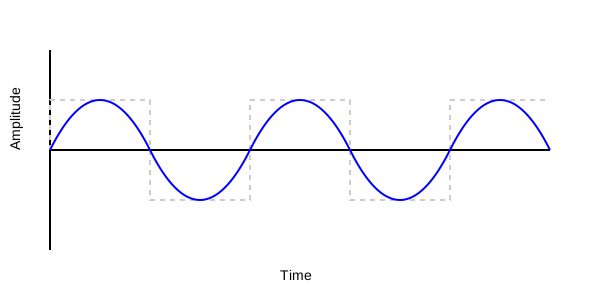
<p>Here is a visual representation of how adding more terms approximates a square wave:</p>

<p><img src="/images/2024-01-10-video-demo/fourier_example.svg" alt="Fourier Series Approximation" /></p>

<p><em>Figure 1: Approximation of a square wave using Fourier Series.</em></p>

<h2 id="applications">Applications</h2>

<p>Fourier series are used in:</p>
<ol>
  <li><strong>Signal Processing</strong>: Filtering and compression.</li>
  <li><strong>Heat Distribution</strong>: Solving the heat equation<sup id="fnref:1:1" role="doc-noteref"><a href="#fn:1" class="footnote" rel="footnote">1</a></sup>.</li>
  <li><strong>Quantum Mechanics</strong>: Wave functions.</li>
</ol>

<h2 id="references">References</h2>

<div class="footnotes" role="doc-endnotes">
  <ol>
    <li id="fn:1" role="doc-endnote">
      <p>Fourier, J. (1822). <em>Théorie analytique de la chaleur</em>. Firmin Didot. <a href="#fnref:1" class="reversefootnote" role="doc-backlink">&#8617;</a> <a href="#fnref:1:1" class="reversefootnote" role="doc-backlink">&#8617;<sup>2</sup></a></p>
    </li>
  </ol>
</div>]]></content><author><name></name></author><category term="dummy" /><category term="math" /><category term="signal-processing" /><summary type="html"><![CDATA[A deep dive into Fourier Series with mathematical examples and visualizations.]]></summary><media:thumbnail xmlns:media="http://search.yahoo.com/mrss/" url="https://mikel-zhobro.github.io/images/2024-01-10-video-demo/fourier_example.svg" /><media:content medium="image" url="https://mikel-zhobro.github.io/images/2024-01-10-video-demo/fourier_example.svg" xmlns:media="http://search.yahoo.com/mrss/" /></entry><entry><title type="html">Video Embedding Demo</title><link href="https://mikel-zhobro.github.io/2024/01/10/video-demo.html" rel="alternate" type="text/html" title="Video Embedding Demo" /><published>2024-01-10T00:00:00+00:00</published><updated>2024-01-10T00:00:00+00:00</updated><id>https://mikel-zhobro.github.io/2024/01/10/video-demo</id><content type="html" xml:base="https://mikel-zhobro.github.io/2024/01/10/video-demo.html"><![CDATA[<p>This post demonstrates how to embed videos in your blog posts.</p>

<h3 id="local-video">Local Video</h3>
<p>You can embed a local video using the <code class="language-plaintext highlighter-rouge">video.html</code> include.
Make sure to place your video file in the <code class="language-plaintext highlighter-rouge">images</code> or <code class="language-plaintext highlighter-rouge">assets</code> folder.</p>

<div class="language-liquid highlighter-rouge"><div class="highlight"><pre class="highlight"><code>
<span class="p">{%</span><span class="w"> </span><span class="nt">include</span><span class="w"> </span>video.html<span class="w"> </span><span class="na">path</span><span class="o">=</span><span class="s2">"/images/sample_video.mp4"</span><span class="w"> </span><span class="na">caption</span><span class="o">=</span><span class="s2">"A sample local video"</span><span class="w"> </span><span class="p">%}</span>

</code></pre></div></div>

<p>(Note: Since we don’t have a real video file at that path, this will show the player but won’t play anything. Please add a valid <code class="language-plaintext highlighter-rouge">.mp4</code> file to your <code class="language-plaintext highlighter-rouge">images</code> folder and update the path.)</p>

<div class="video-container" style="margin: 20px 0; text-align: center;">
  <video width="100%" controls="" style="max-width: 100%; border-radius: 6px; box-shadow: 0 4px 6px rgba(0,0,0,0.1);">
    <source src="/images/3dgsim.mp4" type="video/mp4" />
    Your browser does not support the video tag.
  </video>
  
  <p class="is-size-7 has-text-grey" style="margin-top: 5px;">A sample local video</p>
  
</div>

<h3 id="youtube-video">YouTube Video</h3>
<p>You can also embed YouTube videos using the <code class="language-plaintext highlighter-rouge">youtube.html</code> include and the video ID.</p>

<div class="language-liquid highlighter-rouge"><div class="highlight"><pre class="highlight"><code>
<span class="p">{%</span><span class="w"> </span><span class="nt">include</span><span class="w"> </span>youtube.html<span class="w"> </span><span class="na">id</span><span class="o">=</span><span class="s2">"M7lc1UVf-VE"</span><span class="w"> </span><span class="na">caption</span><span class="o">=</span><span class="s2">"YouTube Developers Example"</span><span class="w"> </span><span class="p">%}</span>

</code></pre></div></div>

<div class="video-container" style="position: relative; padding-bottom: 56.25%; height: 0; overflow: hidden; max-width: 100%; margin: 20px 0; border-radius: 6px; box-shadow: 0 4px 6px rgba(0,0,0,0.1);">
  <iframe src="https://www.youtube.com/embed/M7lc1UVf-VE" style="position: absolute; top: 0; left: 0; width: 100%; height: 100%;" frameborder="0" allow="accelerometer; autoplay; clipboard-write; encrypted-media; gyroscope; picture-in-picture" allowfullscreen="">
  </iframe>
</div>

<p class="is-size-7 has-text-grey has-text-centered" style="margin-top: 5px;">YouTube Developers Example</p>]]></content><author><name></name></author><category term="dummy" /><category term="demo" /><category term="video" /><category term="media" /><summary type="html"><![CDATA[This post demonstrates how to embed videos in your blog posts.]]></summary></entry></feed>